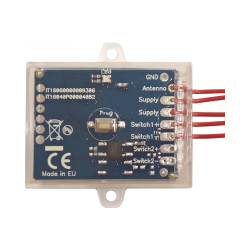
Labai kompaktiškas, 39x39x23 mm, WiFi įrenginys su magnetiniu jutikliu, stebinčiu uždarymo būseną, ir sausu kontaktu (rele), kuris aktyvuojamas 0,5 s, kad atidarytų / uždarytų garažo vartus, vartus ar eismo užtvarą (dabar vadinamas „automatika“).
Išmanusis atidarytuvas turi būti prijungtas prie namų „Wi-Fi“ tinklo: tada išmanusis telefonas gali atidaryti / uždaryti automatiką tiek per „Wi-Fi“ tinklą, tiek per internetą (debesų kompiuteriją): tokiu būdu automatiką galima valdyti nuotoliniu būdu, už „Wi-Fi“ aprėpties zonos ribų./p>
Jokių debesijos mokesčių, jokių metinių mokesčių.
Įrengimas
Būkite atsargūs su elektra. Visus darbus turi atlikti technikai!
Atjunkite nuo sistemos pagrindinį maitinimo šaltinį (110–230 V).
Įrenginiui pasirinkite vietą, kurioje „Wi-Fi“ signalas (2,4 GHz) būtų pakankamai stiprus.
Pasirinktinai (tačiau rekomenduojama) prijunkite magnetinį jutiklį prie S1 ir S2 gnybtų blokų. Jei reikia, galima pridėti papildomą kabelį, kad būtų pasiekta jutiklio „uždarymo padėtis“. Magnetinis jutiklis sudarytas iš dviejų dalių: magneto, kuris turėtų būti sumontuotas mobiliojoje automatikos dalyje, ir aktyviosios dalies su dviem laidais, kuri turėtų būti sumontuota fiksuotoje automatikos dalyje, kad ji būtų suporuota su magnetu tik tada, kai automatika uždaryta. Kai automatika uždaryta, magnetas ir jutiklis turi būti idealiai suporuoti, o atstumas tarp jų turi būti ne didesnis kaip 1 cm.
Prijunkite L1 ir L2 prie mygtuko, naudojamo automatikos atidarymui/uždarymui, arba atitinkamo įvesties elektroninėje plokštėje, valdančioje tjis varikliai.
Prijunkite 110–230 V kintamąją srovę prie L ir N gnybtų blokų.
Įjunkite elektros tinklo maitinimą.
Paspauskite ir atleiskite įrenginio MYGTUKĄ, kad suaktyvintumėte L1/L2 relę ir patikrintumėte, ar automatika tinkamai atsidaro/užsidaro.
Dabar automatizavimą galima valdyti išmaniuoju telefonu ir namų automatikos sistemomis.
Išmaniojo atidarytuvo valdymas naudojant „Smartlife“ arba „Tuya“ programėlę išmaniajame telefone
Išmaniajame telefone įjunkite „Wi-Fi“ ir „Bluetooth“, tada iš „Play“ arba „Apple“ parduotuvės įdiekite programėlę „SmartLife“ arba „Tuya“ (jos yra lygiavertės!), paleiskite programėlę, užregistruokite naują paskyrą (jei jos neturite) arba prisijunkite naudodami esamą vartotojo vardą ir slaptažodį.
Prisijungę, palieskite + piktogramą viršuje dešinėje, kad pridėtumėte išmanųjį atidarymo įrenginį
Paspauskite ir bent 10 sekundžių palaikykite nuspaudę išmaniojo atidarytuvo MYGTUKĄ: po kelių sekundžių ekrane pasirodys nauja piktograma „Išmanieji garažo vartai“: pasirinkite „WiFi“ tinklą, prie kurio norite prisijungti, ir įveskite atitinkamą slaptažodį.

Ilgai paspaudus ekraną, galima pridėti „SmartLife“ arba „Tuya“ valdiklį: tokiu atveju išmanųjį atidarytuvą galima aktyvuoti vienu bakstelėjimu, nereikia atidaryti programėlės.
Išmaniojo atidarytuvo valdymas naudojant „Android Auto“
„SmartLife“ programėlėje sukurkite sceną, skirtą automatizavimui (vartams, garažo vartams arba eismo užtvarui) atidaryti.
Kai išmanusis telefonas susietas su automobiliu, galima bakstelėti programėlių piktogramą -> „SmartLife“ -> „Scena“.atidaryti automatiką.
Žinoma, galima įdiegti daugiau išmaniųjų atidarytuvų, kad būtų galima atidaryti skirtingas automatines sistemas, pavyzdžiui, garažo vartus jūsų namuose, eismo užtvarą darbe ir kt.
„Domoticz“ išmaniojo atidarytuvo valdymas
Naudojant papildinį https://github.com/lacha07/domoticz-tuya-cloud Galima užsiregistruoti „Tuya“ debesyje, pasiekti išmanųjį atidarytuvą, kad „Domoticz“ jį galėtų valdyti per naršyklę (asmeniniame kompiuteryje arba išmaniajame telefone) ir programėlę.
Norėdami užsiregistruoti „Tuya“ API, vadovaukitės aukščiau esančioje nuorodoje pateiktomis instrukcijomis.
Išmaniojo atidarytuvo valdymas naudojant „Home Assistant“
Įdiekite „Tuya“ integraciją, užsiregistruokite „Tuya“ debesyje, kad turėtumėte API raktą, tada galėsite pasiekti išmaniuosius atidarytuvus per „Home Assistant“.
Dažnai užduodami klausimai
Ar magnetinis jutiklis yra privalomas?
Ne, magnetinio jutiklio nereikia montuoti: tokiu atveju „SmartLife“ / „Tuya“ programėlėje turite išjungti pranešimus apie atidarytą būseną, kad išvengtumėte įspėjimų apie automatikos atidarytą būseną.
Ar galiu išmanųjį atidarytuvą įdėti į DIN bėgelio dėžutę?
Taip, jame yra plastikas Laikiklis tvirtinimui prie DIN bėgelio, užimantis 2,5 modulio (43 mm).
Smart-Home Creasol DomBus modules for Domoticz, Home Assistant, Node-RED, OpenHAB, ...
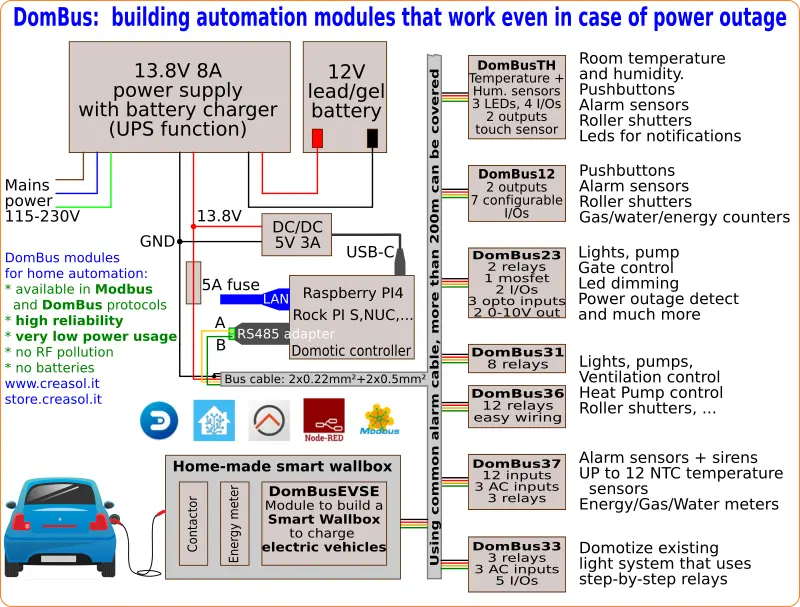
The following video shows a presentation of some domotic modules designed and produced in Italy by Creasol to make a reliable, easy and power-optimized home automation system.
The next video shows our Smart EVSE module that can be used to charge the electric car by using only solar power, or adding 25/50/75/100% of available power from the electrical grid.
Our industrial and home automation modules are designed to be
very low power (around 10mW with relays OFF)
reliable (no disconnections)
bus connected (no radiofrequency interference, no battery to replace).
Modules are available in two version:
with DomBus proprietary protocol, working with Domoticz only
For our products we can offer FULL SUPPORT and CUSTOMIZATION: please contact us by Email or Telegram
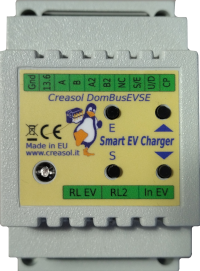
DomBusEVSE - EVSE module to build a Smart Wallbox / EV charging station
Complete solution to make a Smart EVSE, charging the electric vehicle using only energy from renewable source (photovoltaic, wind, ...), or adding 25-50-75-100% of available power from the grid.
Single-phase and three-phases, up to 36A (8kW or 22kW)
Needs external contactor, RCCB (protection) and EV cable
Optional power meter to measure charging power, energy, voltage and power factor
Optional power meter to measure the power usage from the grid (not needed if already exists)
Two max grid power thresholds can be programmed: for example, in Italy who have 6kW contractual power can drain from the grid Max (6* 1.27)=7.6kW for max 90 minutes followed by (6* 1.1)=6.6kW for another 90 minutes. The module can use ALL available power when programmed to charge at 100%.
Works without the domotic controller (stand-alone mode), and can also work with charging current set by the domotic controller (managed mode)
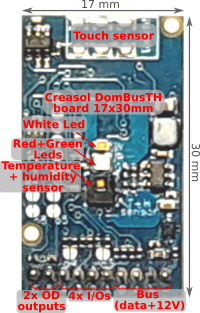
DomBusTH - Compact board to be placed on a blank cover, with temperature and humidity sensor and RGW LEDs
Compact board, 32x17mm, to be installed on blank cover with a 4mm hole in the middle, to exchange air for the relative humidity sensor. It can be installed in every room to monitor temperature and humidity, check alarm sensors, control blind motor UP/DOWN, send notifications (using red and green leds) and activate white led in case of power outage.
Includes:
temperature and relative humidity sensor
red, green and white LEDs
4 I/Os configurable as analog or digital inputs, pushbuttons, counters (water, gas, S0 energy, ...), NTC temperature and ultrasonic distance sensors
2 ports are configured by default as open-drain output and can drive up to 200mA led strip (with dimming function) or can be connected to the external module DomRelay2 to control 2 relays; they can also be configured as analog/digital inputs, pushbuttons and distance sensors.
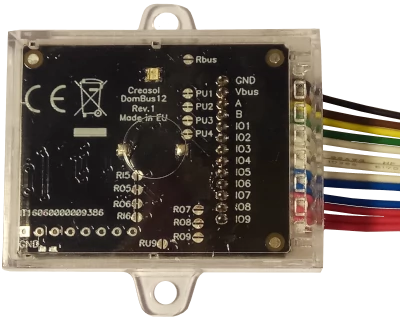
DomBus12 - Compact domotic module with 9 I/Os
Very compact, versatile and cost-effective module with 9 ports. Each port can be configured by software as:
analog/digital inputs
pushbutton and UP/DOWN pushbutton
counters (water, gas, S0 energy, ...)
NTC temperature and ultrasonic distance sensors
2 ports are configured by default as open-drain output and can drive up to 200mA led strip (with dimming function) or can be connected to the external module DomRelay2 to control 2 relays.
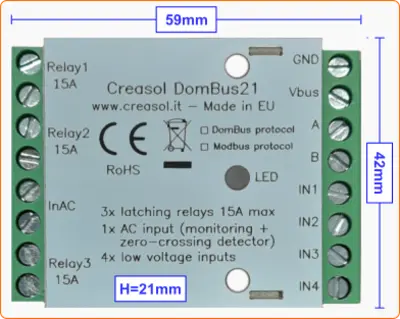
DomBus21 - Power optimized module with 3 High Power latching relays, 1 AC input and 4 low voltage inputs
Very low power consumption module designed to enable up to 3 high power loads, up to 15A (3kW).
3x high power latching relays SPST 15A: latching relay consumes nothing when ON
1x 230V AC opto-isolated input used as power outage detector, and also as zero-crossing detector to permit switching relays On/Off minimizing in-rush current (for capacitive loads) and overvoltage (for inductive loads)
4x low voltage inputs, that can be connected to pushbuttons, switches, meters with pulsed output, NTC temperature sensors, ...
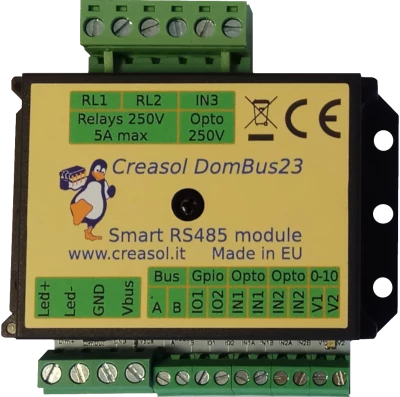
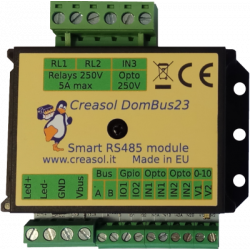
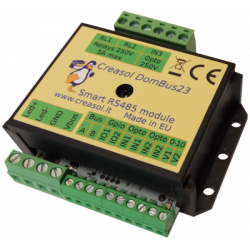
DomBus23 - Domotic module with many functions
Versatile module designed to control gate or garage door.
2x relays SPST 5A
1x 10A 30V mosfet (led stripe dimming)
2x 0-10V analog output: each one can be configured as open-drain output to control external relay
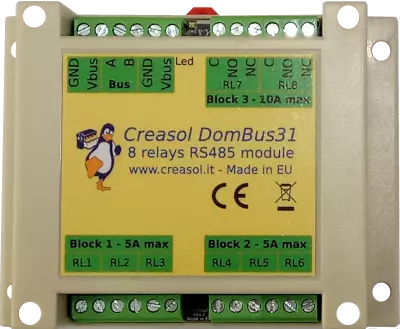
DIN rail low profile module, with 8 relays and very low power consumption:
6x relays SPST 5A
2x relays STDT 10A
Only 10mW power consumption with all relays OFF
Only 500mW power consumption with all 8 relays ON !!
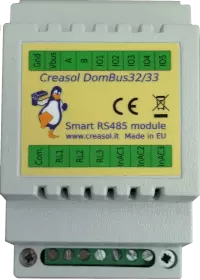
DomBus32 - Domotic module with 3 relays
Versatile module with 230V inputs and outputs, and 5 low voltage I/Os.
3x relays SPST 5A
3x 115/230Vac optoisolated inputs
Single common for relays and AC inputs
5x general purpose I/O, each one configurable as analog/digital inputs, pushbutton, counter, temperature and distance sensor.
DomBus33 - Module to domotize a light system using step relays
Module designed to control 3 lights already existing and actually controlled by 230V pushbuttons and step-by-step relays. In this way each light can be activated by existing pushbuttons, and by the domotic controller.
3x relays SPST 5A
3x 115/230Vac optoisolated inputs
Single common for relays and AC inputs
5x general purpose I/O, each one configurable as analog/digital inputs, pushbutton, counter, temperature and distance sensor.
Each relay can toggle the existing step-relay, switching the light On/Off. The optoisolator monitors the light status. The 5 I/Os can be connected to pushbuttons to activate or deactivate one or all lights.
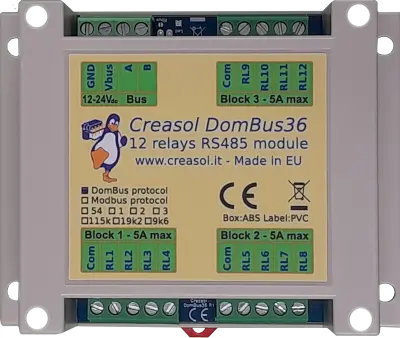
DomBus36 - Domotic module with 12 relays
DIN rail module, low profile, with 12 relays outputs and very low power consumption.
12x relays SPST 5A
Relays are grouped in 3 blocks, with a single common per block, for easier wiring
Only 12mW power consumption with all relays OFF
Only 750mW power consumption with all 12 relays ON !!
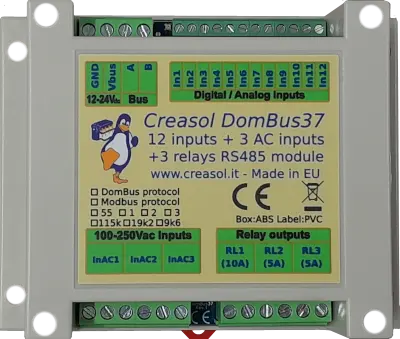
Module designed to be connected to alarm sensors (magnetc contact sensors, PIRs, tampers): it's able to monitor mains power supply (power outage / blackout) and also have 3 relays outputs.
12x low voltage inputs (analog/digital inputs, buttons, alarm sensors, balanced double/triple biased alarm sensors, counters, temperature and distance sensors, ...)
3x 115/230Vac optoisolated inputs
2x relays SPST 5A
1x relay SPST 10A
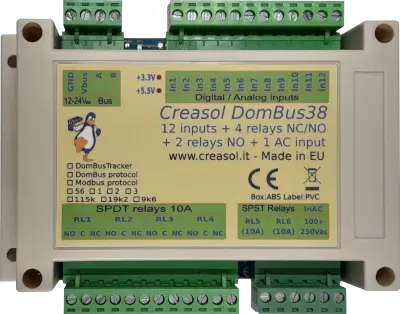
DomBus38 - 4 SPDT 10A relays, 2 SPST 10A relays, 1 AC input, 12 low voltage inputs
DIN rail module designed for burglar alarm system.
4x relays SPDT (normally open + close contacts), 10A
2x relays SPST 10A
1x 115/230Vac optoisolated inputs, that can be used to monitor 230V voltage presence (blackout detector) and it's also used as zero-crossing detector to minimize in-rush current and overvoltage when a relay switches On/Off
12x low voltage inputs (analog/digital inputs, buttons, alarm sensors, balanced double/triple biased alarm sensors, counters, temperature and distance sensors, ...)
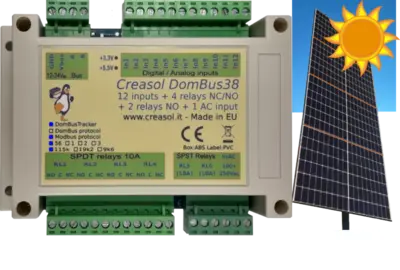
DomBusTracker - Smart dual-axis sun tracker to optimize photovoltaic production
DIN rail module that control azimuth + elevation/tilt motors of a sun tracker, to maximize photovoltaic energy production during the day and seasons.
Uses a deep-hole sun sensor, to optimize production with both sunny and cloudy weather
Works in stand-alone mode (no need for external controller)
Can be connected to Domoticz for monitoring and controlling the motors position
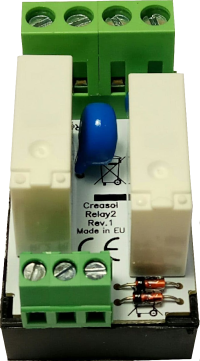
DomRelay2 - 2x relays board
Simple module with 2 relays, to be used with DomBus modules or other electronic boards with open-collector or open-drain outputs
2x 5A 12V SPST relays (Normally Open contact)
Overvoltage protection (for inductive loads, like motors)
Overcurrent protection (for capacitive laods, like AC/DC power supply, LED bulbs, ...)
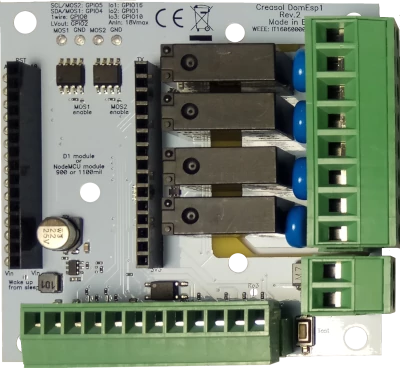
DomESP1 / DomESP2 - Board with relays and more for ESP8266 NodeMCU WiFi module
IoT board designed for NodeMCU v3 board using ESP8266 WiFi microcontroller
9-24V input voltage, with high efficiency DC/DC regulator with 5V output
4x SPST relays 5V with overvoltage protection
1x SSR output (max 40V output)
2x mosfet output (max 30V, 10A) for LED dimming or other DC loads
1x I²C interface for sensors, extended I/Os and more)
1x OneWire interface (DS18B20 or other 1wire sensors/devices)




 Italiano
 English
 Deutsch
 Français
 Español
 Português
 Dutch
Dutch
 Danish
 Norwegian
 Swedish
 Finnish
 Czech
Czech
 Hungarian
 Latvian
 Lithuanian
 Polish
 Romanian
 Slovak
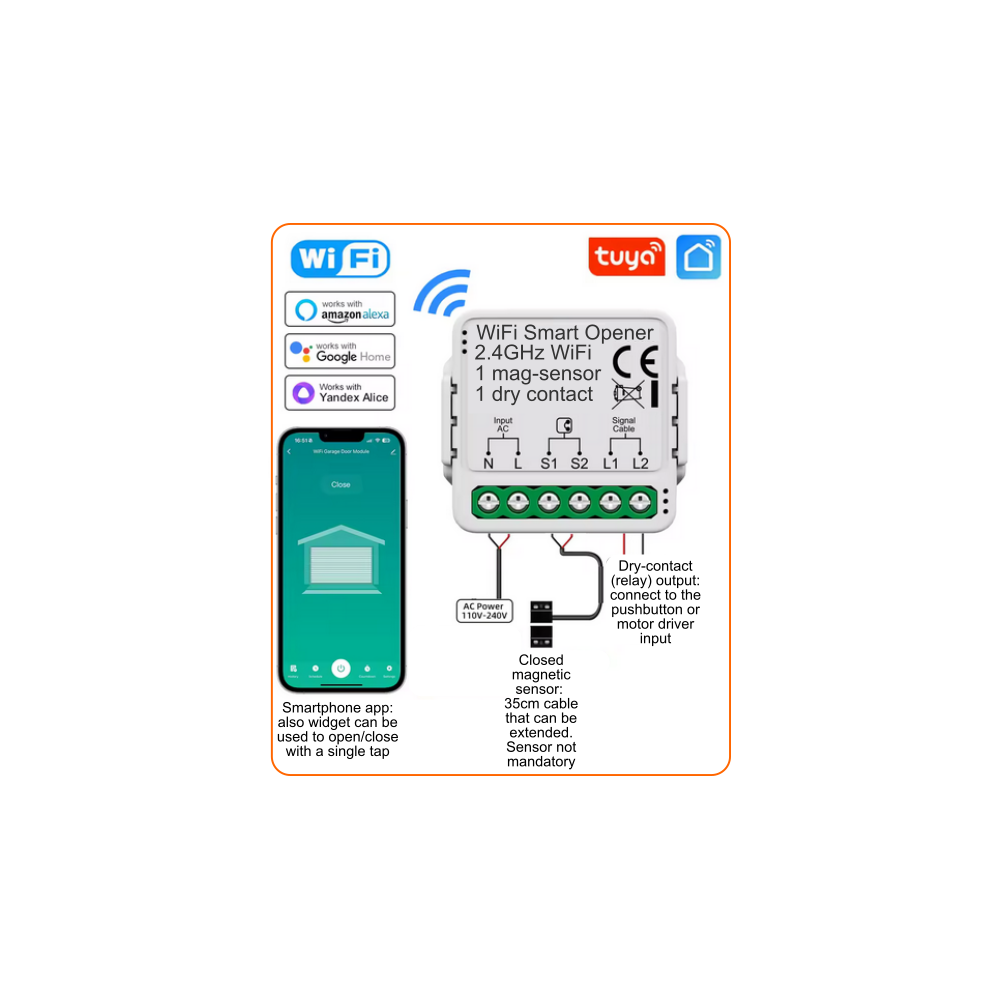
 Labai kompaktiškas, 39x39x23 mm, WiFi įrenginys su magnetiniu jutikliu, stebinčiu uždarymo būseną, ir sausu kontaktu (rele), kuris aktyvuojamas 0,5 s, kad atidarytų / uždarytų garažo vartus, vartus ar eismo užtvarą (dabar vadinamas „automatika“).